Nu Mexico – Cajitas 2.0
Redesigning the savings experience so users can see their money growing – not just that it exists.
Role
Product Designer
Role
4-hour Claude-assisted sprint
Platform
iOS · Nu Mexico
Tools
Figma · Claude AI · Mobbin
Type
Concept redesign
01 — Context
What is Nu Mexico and why Cajitas?
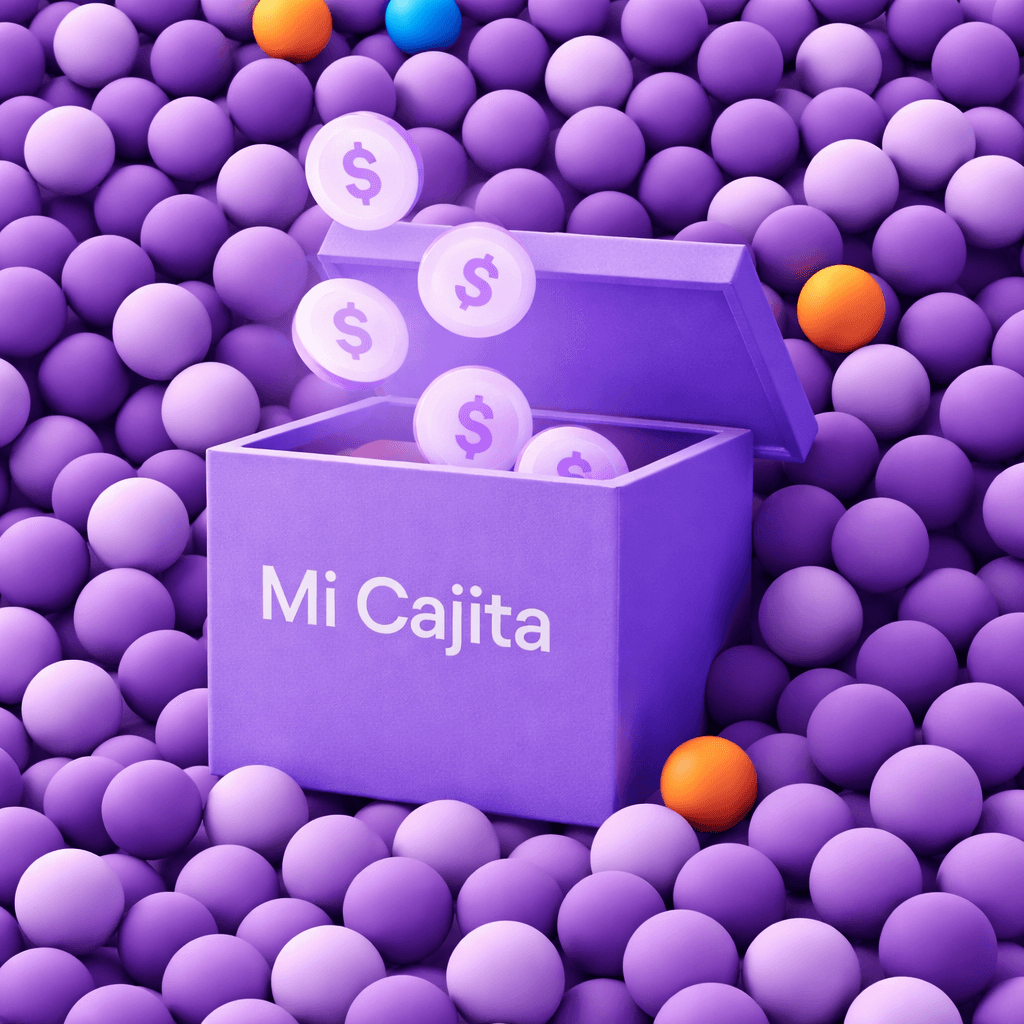
Nu Mexico (Nubank) is one of Latin America's fastest-growing digital banks, serving millions of customers across Mexico with a credit card, debit account, and savings product called Cajitas — a high-yield savings pocket that earns interest daily at rates tied to Banxico (Mexico's central bank).
Cajitas is Nu's most differentiated product in the Mexican market. Unlike traditional savings accounts, it offers competitive annual yields (currently 13%) with no lock-in period. Users can create multiple cajitas for different goals, name them, and move money freely.
But there's a problem. Despite strong yield numbers, users don't feel their money growing. The app shows a balance — it doesn't show growth. That gap between what the product delivers and what users perceive is the design problem this project addresses.
13%
Annual yield
on Cajita Turbo
200+
User reviews
analyzed
4
Core pain points
identified
4
Redesigned
screens
02 — Discover
What users are actually saying
I screened 200+ reviews across App Store Mexico, Google Play, and Reddit (r/MexicoFinanciero, r/ColombiaFinanciera) — filtering out credit, payments, and app performance feedback to focus on savings. 35+ reviews spoke directly to Cajitas. No surveys, no interviews — just users publicly describing their real experience.
Five clear clusters emerged from the data, ranked by frequency and emotional intensity:

Llegué a los 100k en mi cajita... y tuve que venir a Reddit a celebrarlo porque la app no me dijo nada.
— Reddit, r/MexicoFinanciero · 814 upvotes
Por qué bajó mi rendimiento? Nadie me avisó. Tuve que buscar en Google qué pasó con Banxico.
— App Store Mexico · 2-star review
"Nu Mexico's Cajitas shows users that their money exists, but never shows them that it's working. No growth visualization, no milestone moments, no rate context — leaving engaged savers without the feedback loop that would keep them saving more."
03 — Define
Who we're designing for
Two personas emerged from the research — complementary, not redundant. Together they cover the full spectrum of Nu's savings users.

Carlos M., 28
Software engineer · CDMX · Nu user 14 months · $25–45k MXN/mo
Second digital bank. Saves by habit, checks the app 3–4 times a week. Goes to Reddit to understand how his own product works. Trusts Nu but can't verify the yield is real.

Sofia R., 25
Fotógrafa freelance · Guadalajara · Nu user 8 months · $20–35k MXN/mo
Saving for a specific goal — trip to Japan, $75,000 MXN target. Uses Apple Notes to track what Nu should be tracking. Variable income makes goal progress especially important to see.
Four hypotheses
Based on the research, I defined four testable hypotheses — one per pain point. Each is structured as an if/then/because statement, not a feature wishlist.
H1
Feedback loop — If we show users a daily yield counter and transaction history with running balances, then support queries about "why isn't my cajita growing" will decrease, because users will be able to verify growth themselves without leaving the app.
H2
Goal setting — If users can set a savings target and deadline per cajita, then monthly deposit consistency will increase, because a visible goal creates a commitment mechanism that a nameless savings account doesn't.
H3
Milestone celebration — If we add a milestone screen when a goal is reached, then 30-day retention after goal completion will improve and organic social sharing will increase, because users currently have no in-app moment to mark the achievement.
H4
Rate transparency — If we proactively explain rate changes with context (Banxico decision, comparison to previous rate, positioning vs CETES), then withdrawal rate in the 48 hours after a rate change will decrease, because anxiety comes from silence, not from the change itself.
04 — Design System
Extracting Nu's design language
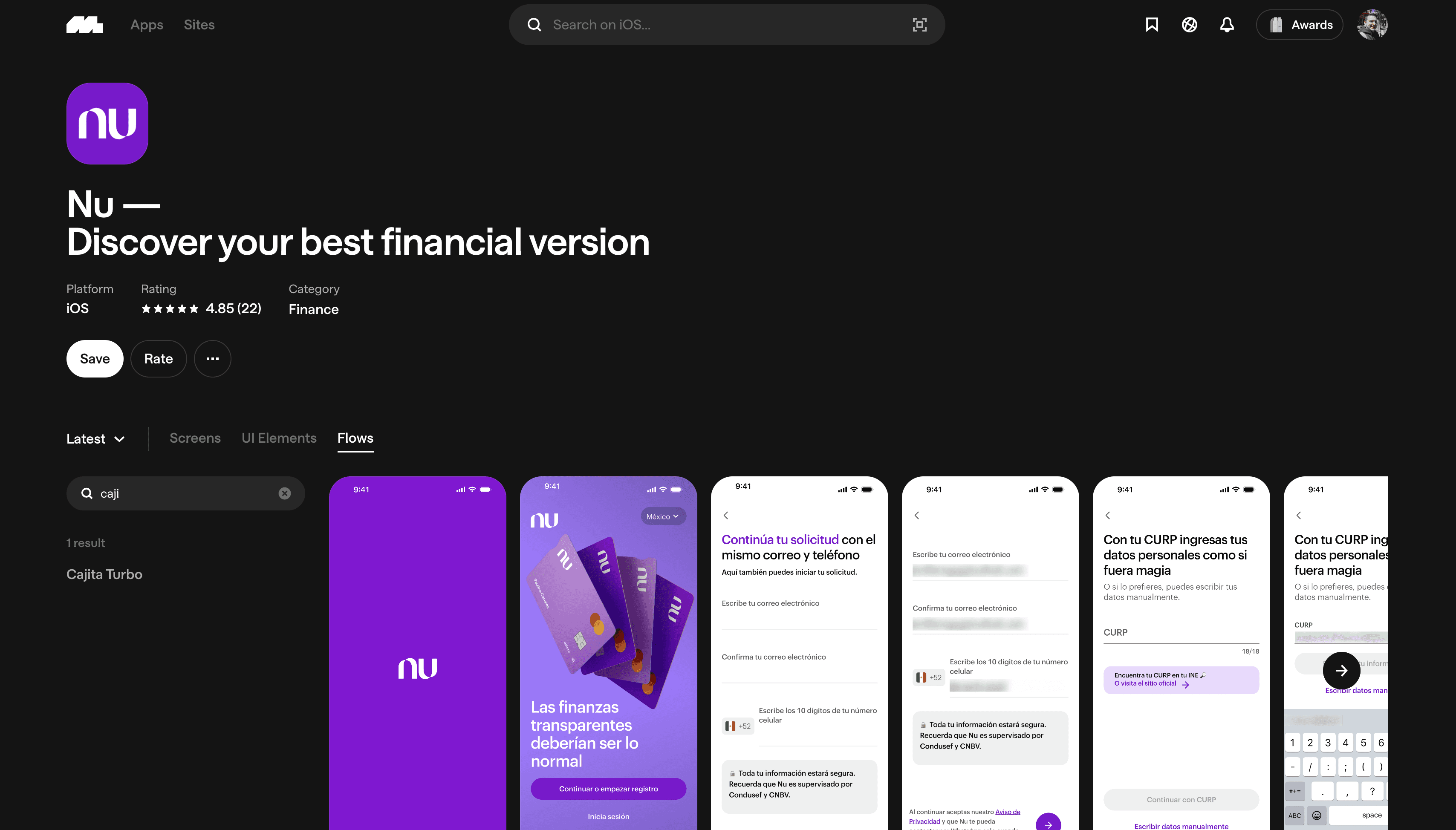
Rather than guessing Nu's design tokens, I extracted them directly from screenshots of the live app using Mobbin — a library of real production UI flows. This gave me pixel-accurate color values, typography scales, spacing, and component patterns.
I built only what the redesign needed: 8 new components on top of Nu's existing token foundation. Not a full design system — a targeted extension.
Key new components: progress bar with goal tracking, area growth chart with event annotations, transaction history with running balances, live "generating" indicator, milestone celebration card, and rate change notification modal.
05 — Redesign
From invisible balance to a savings feedback loop
Each screen maps directly to one hypothesis. Design decisions were driven by research findings, not aesthetic preference.
What exists today
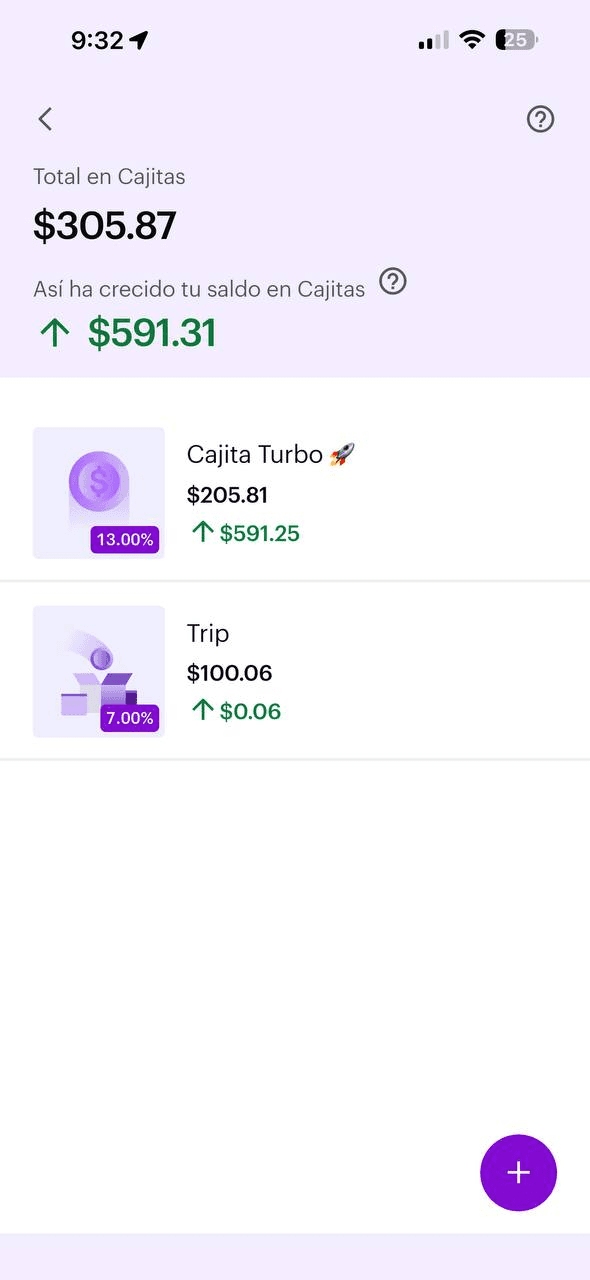
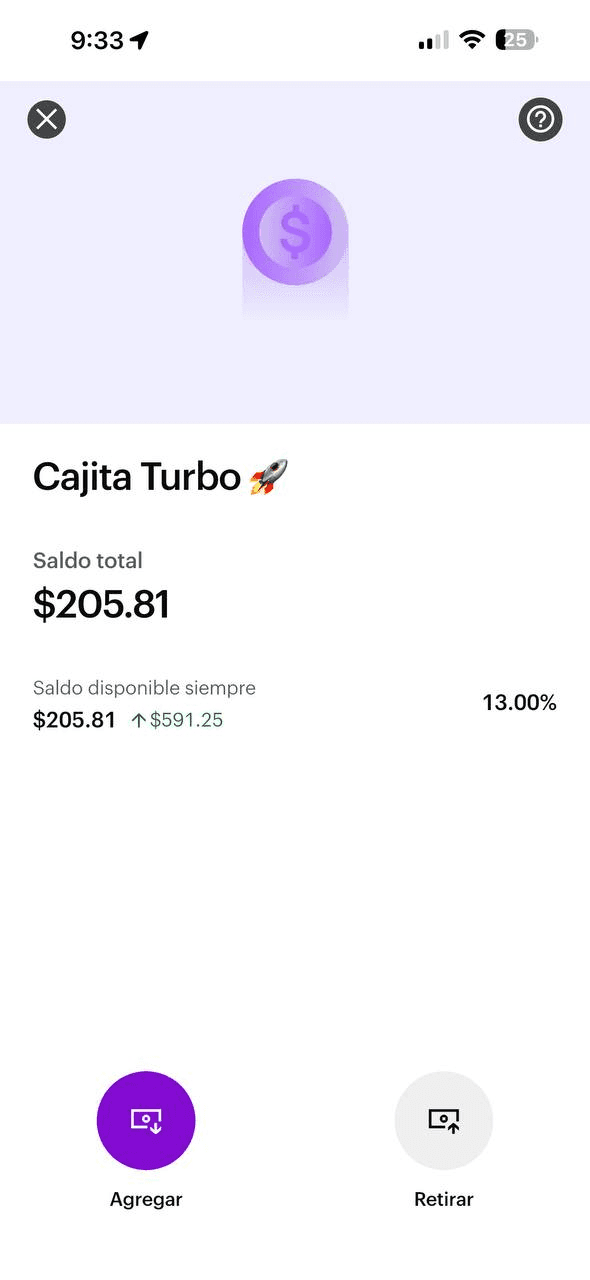
Two screens captured from the live Nu Mexico app in March 2026. The home screen shows a total balance and a cumulative yield number with no time context — users can't tell if their money grew today, this week, or ever. The detail screen shows a static balance, a rate buried in a tooltip, and no transaction history. There is no way to verify the money is actually working.
Cajitas Home
Two cajitas showing identical yield numbers. The growth label reads "Así ha crecido tu saldo en Cajitas" — but with no daily breakdown, and no goal progress, users have no reference point for what that number means or whether it's good.
Cajitas Detail
A static balance, a 13% rate shown without explanation, and a tooltip that answers nothing. No transaction history, no daily yield, no growth visualization. Users deposit money and then have no way to confirm it's earning anything.
Cajita Home Iterations
The home screen needed to answer three things at once — is my money active, am I on track, and how much did I earn today. I explored 4 directions, each adding one layer of information until the card could stand alone.
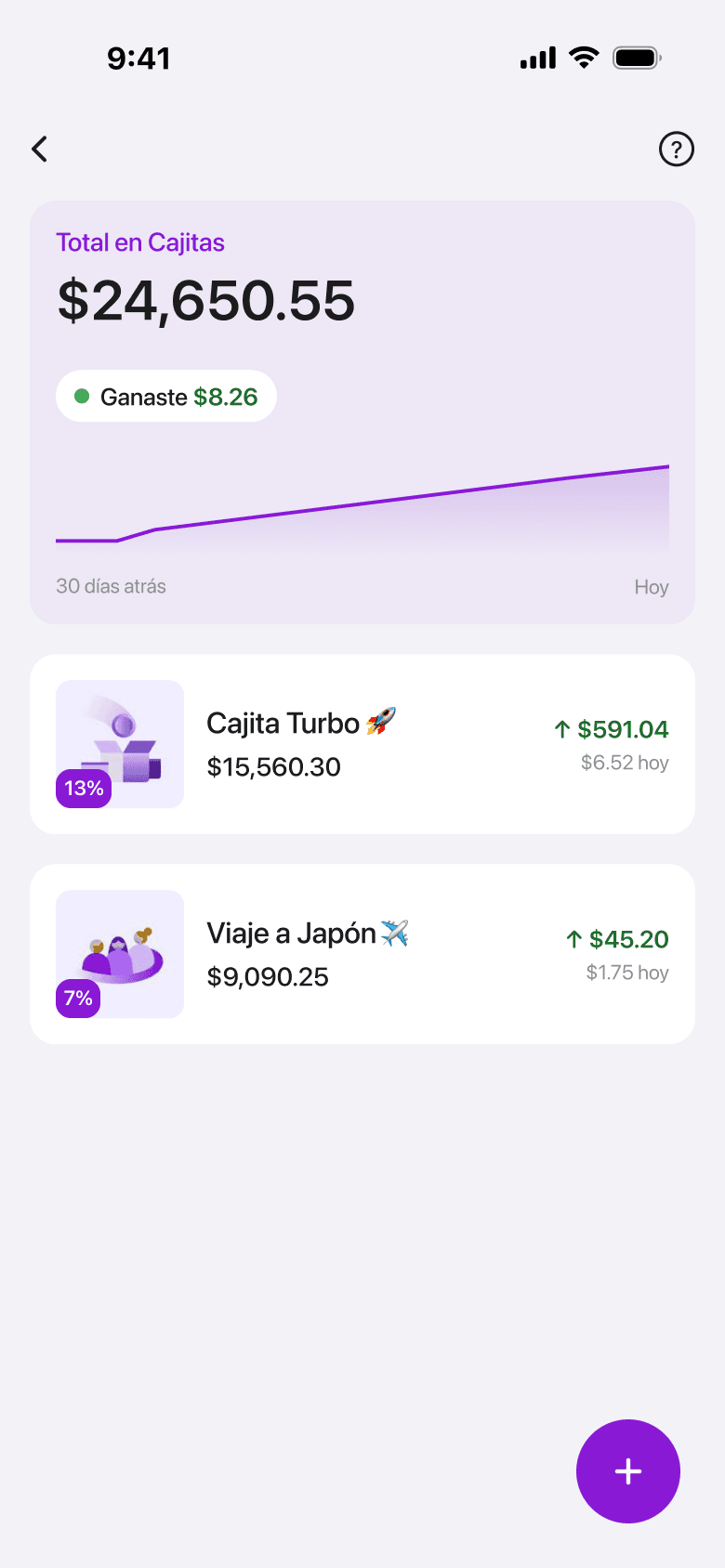
V1 - Sparkline variant
A portfolio-level chart instead of per-cajita indicators. Clean but incomplete — no goal context, no rate visibility per cajita.
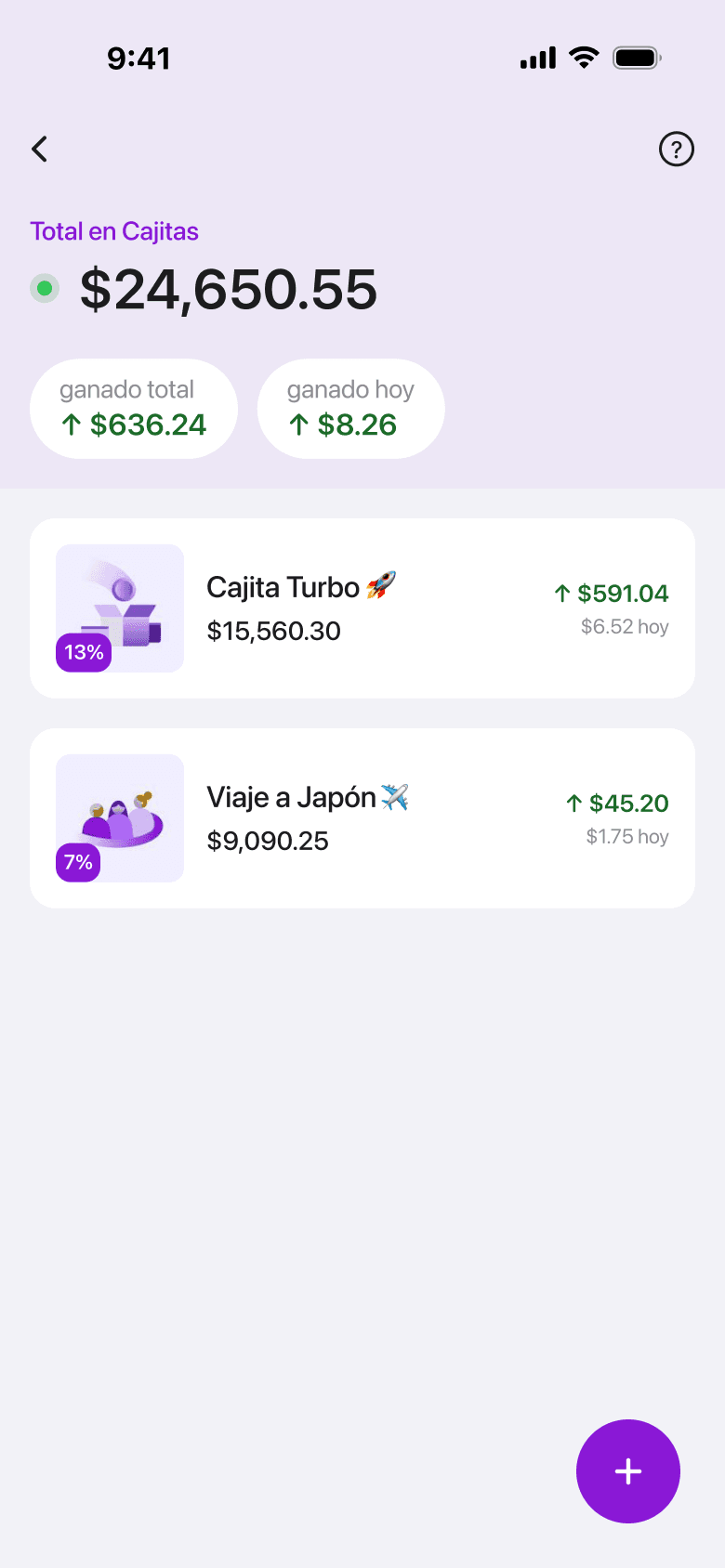
V2 - Live dot + rate badge
Added pulse indicator and "ganado total." The green dot signals activity but doesn't show which cajita is generating or at what rate.
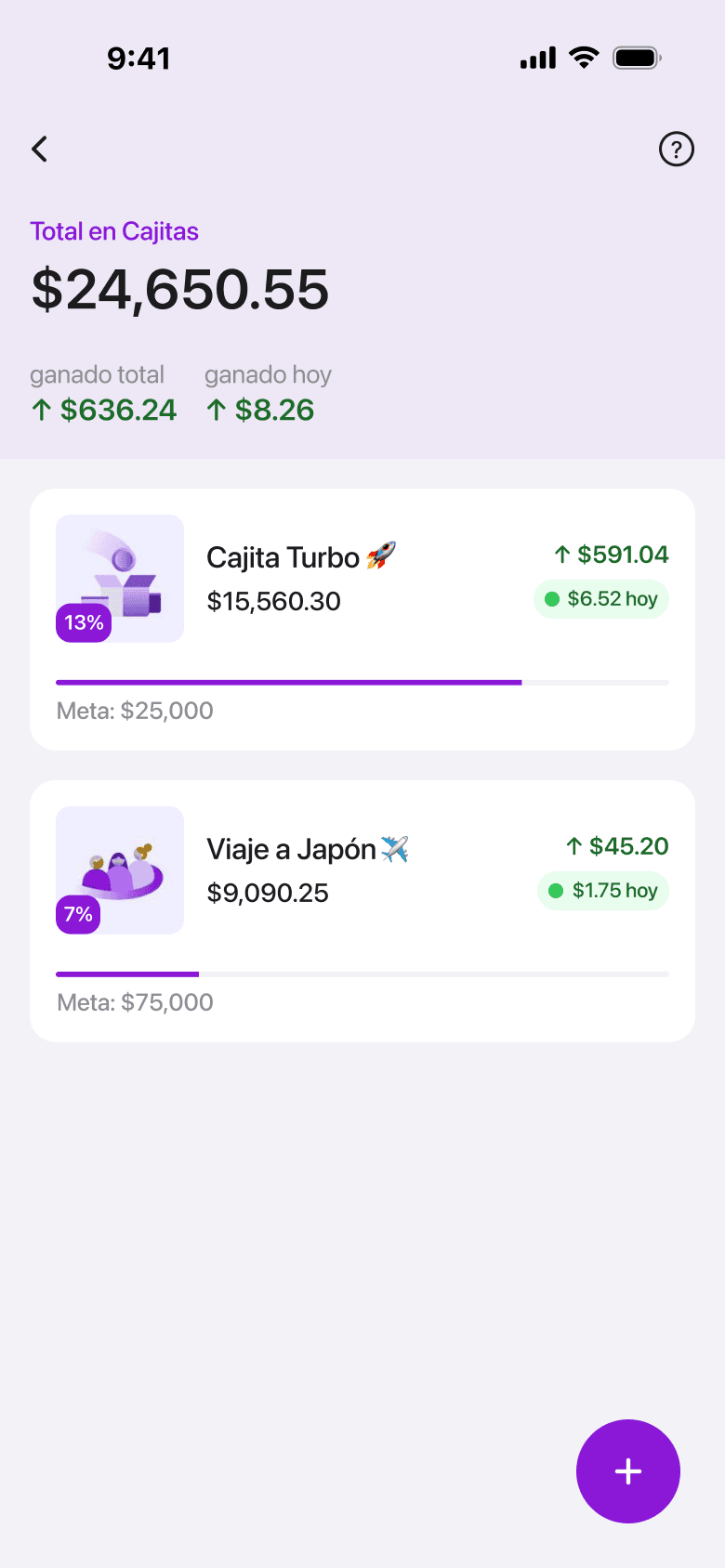
V3 - Progress bar + today pill
First version with goal progress per cajita. Answers "am I on track?" — but the rate stays hidden behind the icon badge.
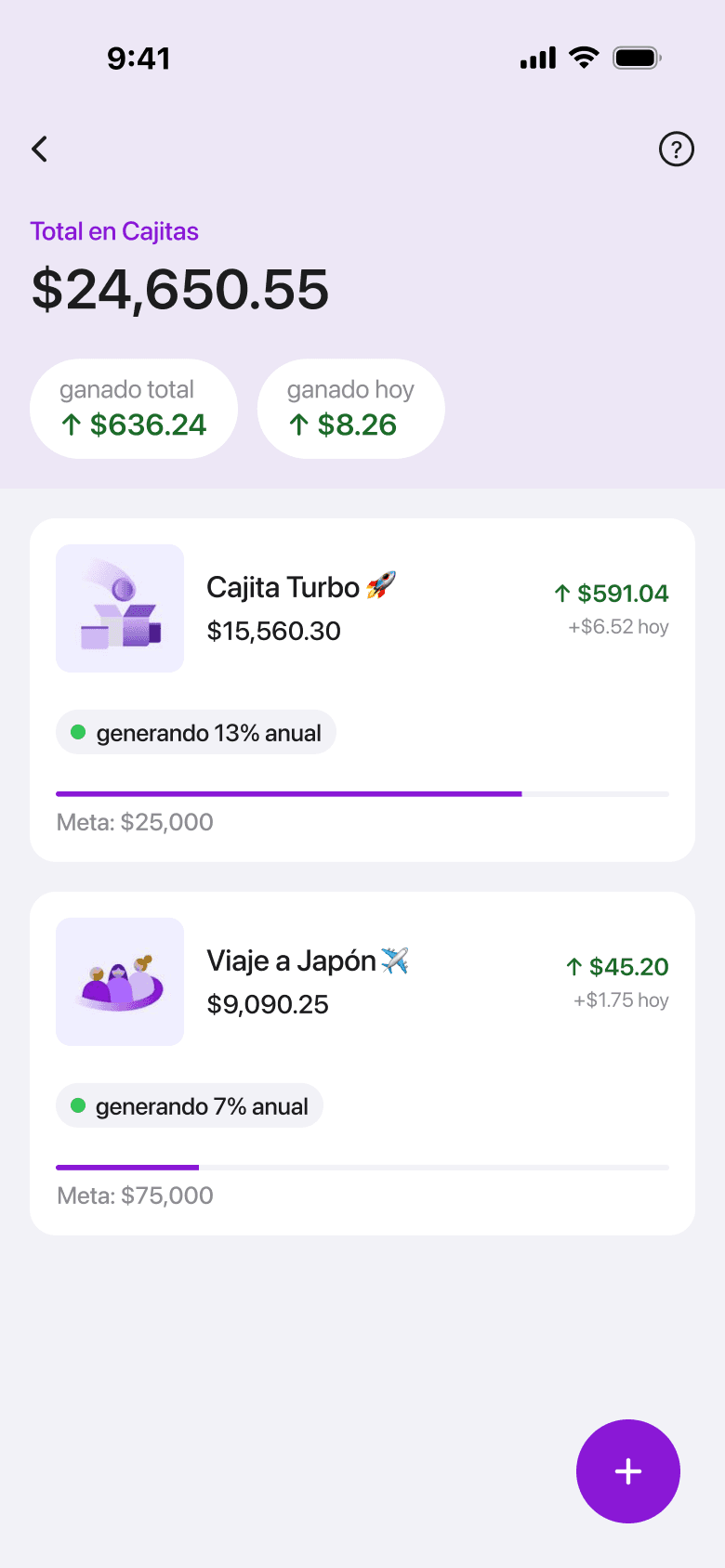
V4 - Rate label + progress bar
Rate moves into the card body as "generando 13% anual." One card now answers everything: earned, active, rate, goal progress.
Cajitas Home
Pain points solved
Users couldn't tell if their cajita was actively generating yield or sitting idle. The interest rate was hidden behind a small badge — visible but not readable as meaningful information.
Key new elements
"Generando 13% anual" label inside the card body — rate is now a statement, not a decoration. Progress bar with goal amount. Daily yield as plain text alongside total earned. All key signals in one card without opening the detail screen.
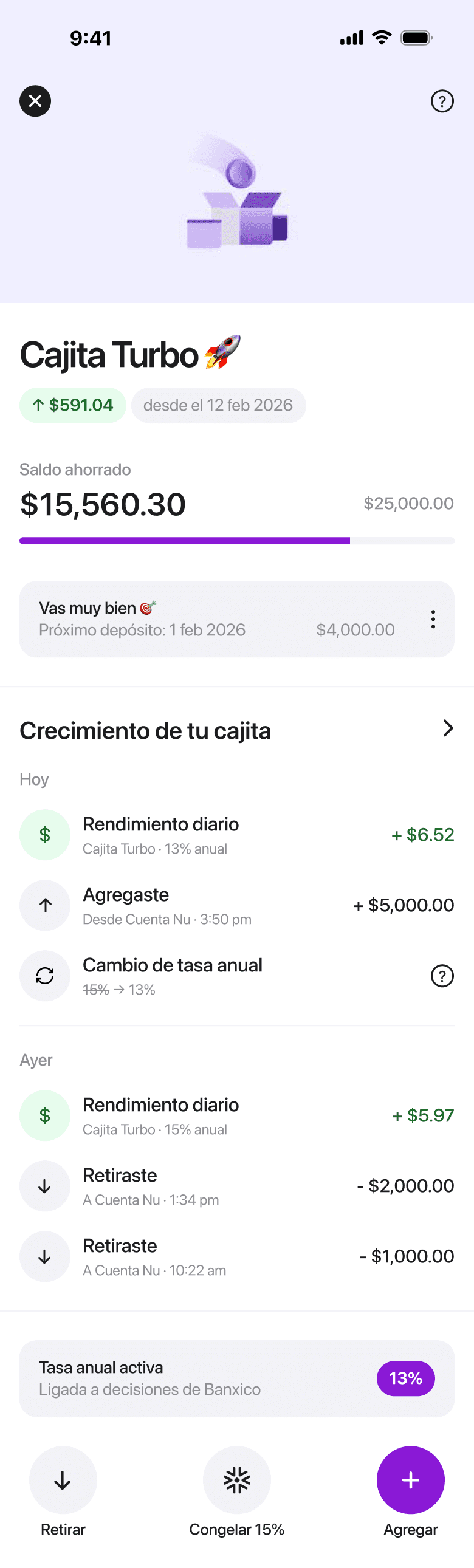
Cajita Detail
Pain points solved
Users saw a static balance with no history — no way to verify their yield was real or understand what happened to their money between deposits and withdrawals.
Key new elements
Transaction feed grouped by day with running balances. Daily yield entry per row. Rate shown per transaction so changes are traceable.
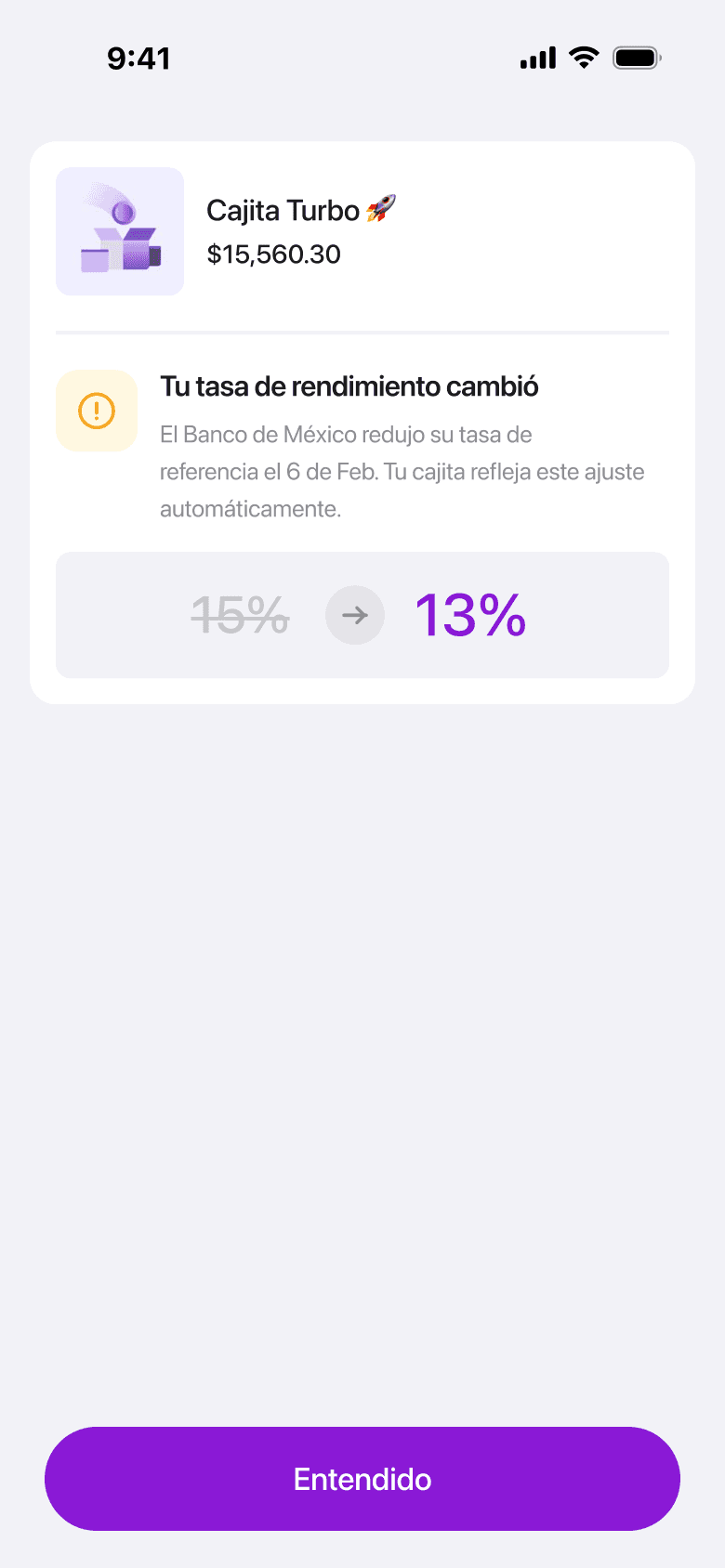
Rate Change Notification
Pain points solved
When Banxico adjusted rates, Cajita yields changed silently. No notification, no explanation — users discovered a lower number and withdrew out of confusion, not disagreement.
Key new elements
Old rate struck through, new rate in bold purple. Plain-Spanish Banxico explanation. Reassurance line that the cajita is working normally.
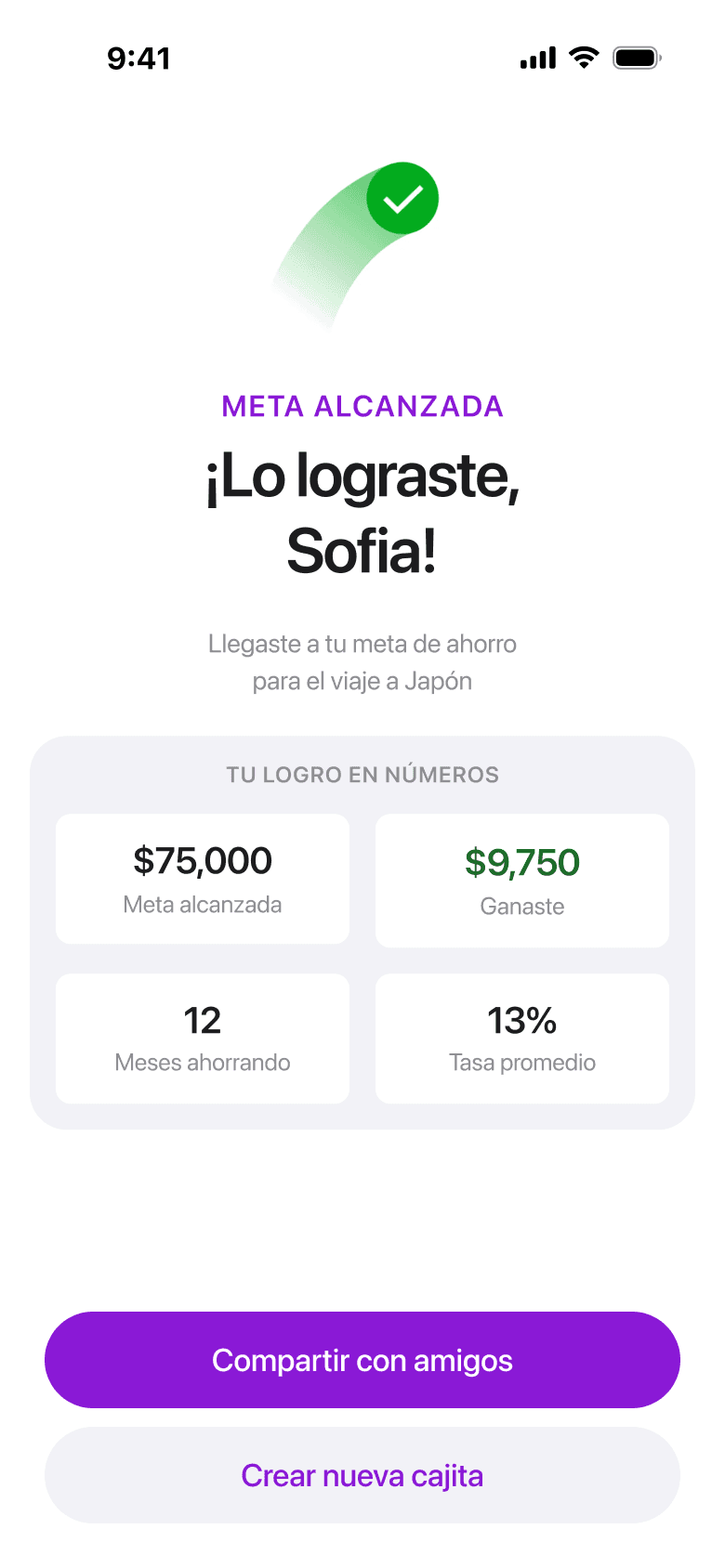
Goal Achieved Celebration
Pain points solved
Users who reached a savings milestone had no moment of recognition inside the app.
Key new elements
Full-screen celebration with green checkmark and confetti. Stats card showing goal reached, total yield earned, months saving, and average rate.
Key design decisions
D1
Transaction history over static balance
The original "Crecimiento de tu cajita" section was empty — no data, no history, no way to verify yield was real. A transaction feed grouped by day with running balances replaced it. Users can now trace every peso: when they deposited, when they withdrew, and exactly how much the cajita earned each day.
D2
Rate change as a conversation, not a surprise
A silent rate drop created more anxiety than the drop itself. The notification screen turns a system event into a transparent explanation — old rate struck through, new rate prominent, Banxico cited by name. Users understand what changed and why before they have a chance to panic.
D3
Live indicator with rate, not just a green dot
A static dot signals "active" but nothing else. Moving the rate into the card body as "generando 13% anual" turns a decorative element into useful information — users see their money is working and at what rate, without opening anything.
D4
Milestone screen as the product's emotional peak
Reaching a savings goal is a significant moment that Nu currently ignores. The celebration screen gives users a shareable stats card with the numbers that matter — goal reached, yield earned, months saving. The Reddit screenshot moment now happens inside the app.
06 — Measure
How we'd know if it worked
This is a concept redesign — no A/B test, no production data. But defining success metrics before testing is standard practice in product design. The hypotheses were validated qualitatively by 35+ real user reviews. The next step would be a quantitative A/B test with Nu Mexico's user base.
Baselines are estimated from industry benchmarks for Latin American neobanks and the Reddit complaint volume — not invented, but extrapolated from the research.
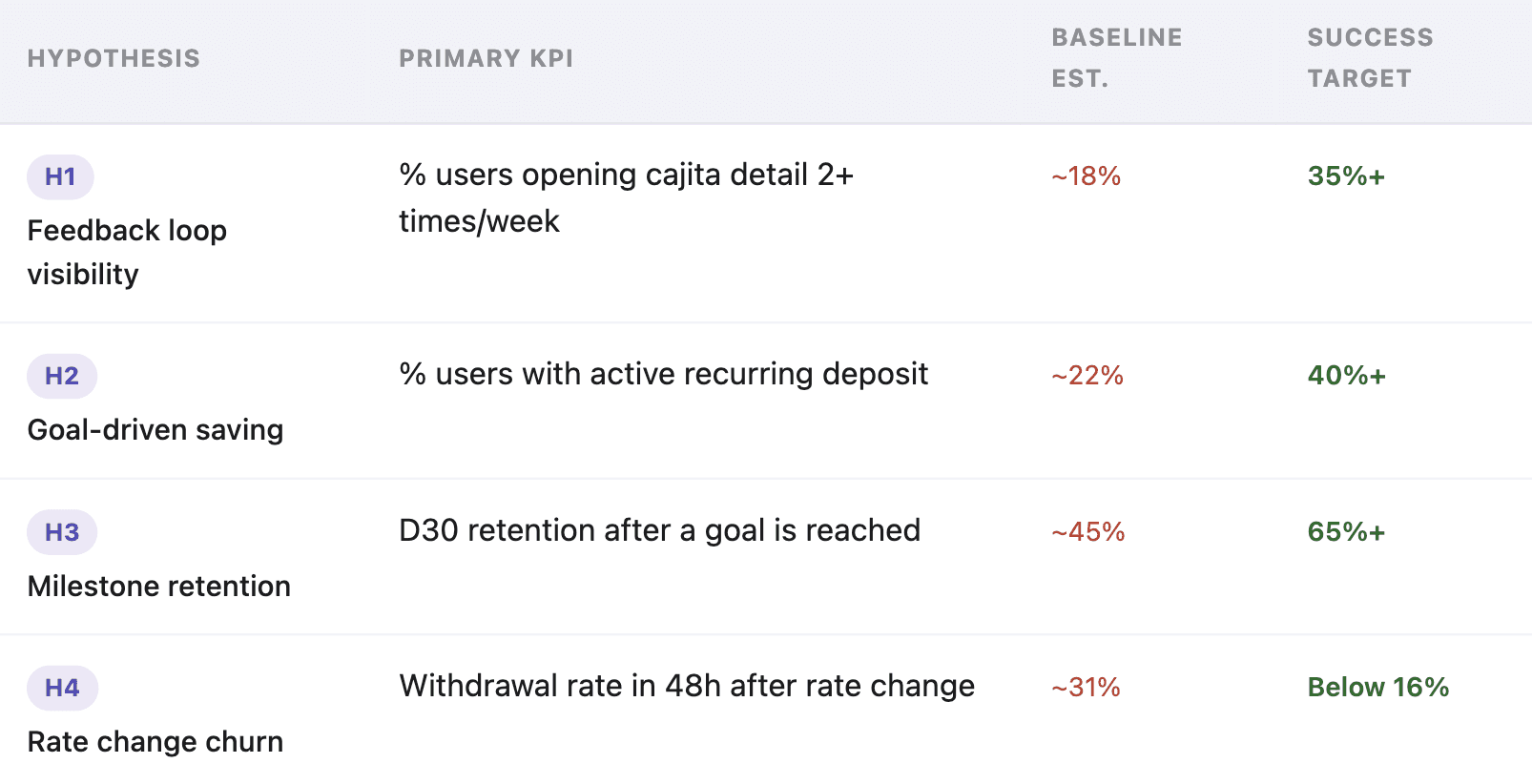
The 200+ user reviews aren't just background research — they're qualitative validation of all four hypotheses. Real users, real names, describing exactly the pain points this redesign addresses. That's more authentic signal than a biased usability test.
07 — Methodology
AI-assisted design sprint
This project was completed in a 4-hour focused sprint using Claude AI as a thinking partner throughout the process.
08 — Reflection
What I learned
What worked
Starting from real user language rather than assumptions. The Reddit quote that became the case study thesis — "tuve que venir a Reddit a celebrarlo porque la app no me dijo nada" — shaped every design decision. When research is that specific, design decisions become obvious.
What worked
Treating financial numbers as design elements. Incorrect yield math destroys trust faster than bad visual design. Verifying every number in the mockup against actual rate calculations was as important as the layout work.
What I'd do differently
I'd add a competitive analysis slide before the redesign — showing Monzo Pots, Revolut Vaults, and Ualá's goal tracking. Not to copy, but to establish what the market has already solved so the design rationale becomes "we're catching up to the benchmark" rather than "we invented this."
Next steps
Prototype the transaction history interaction — specifically how the running balance updates when you tap on a transaction row. That micro-interaction is the core emotional moment of the redesign and it needs motion to feel right. A quantitative A/B test with 500 Nu Mexico users would be the real validation.
The most interesting design problem wasn't the visual design — it was the product thinking. A user who withdrew everything and restarted their cajita should see "earned this session" separately from "earned lifetime." That edge case reveals something about how the product thinks about continuity of savings identity. I'd want to explore that with the Nu team.